India Is Buying EVs. But Are Indian Homes Ready to Charge Them?
Akshay Shekhar of Kazam on the hidden infrastructure crisis sitting inside India's EV revolution and the report that finally documents it.
The 2047 Snapshot
Picture India in 2047, a century after independence. Every new vehicle sold in the country runs on electricity. Solar energy flows from rooftops across cities and towns. A delivery rider in Siliguri charges his three-wheeler overnight and earns in the morning. A family in a Gurgaon apartment wakes up to a fully charged car without ever visiting a fuel station.
That is the destination India has set for itself.
Now ask a simpler, more uncomfortable question: can the homes where those EVs will park every night actually charge them safely?
The answer, today, is: in nearly half of Indian homes, no — not without significant intervention. And this is the story that India's electric vehicle conversation has barely begun to have.
23 Lakh EVs. One Invisible Problem.
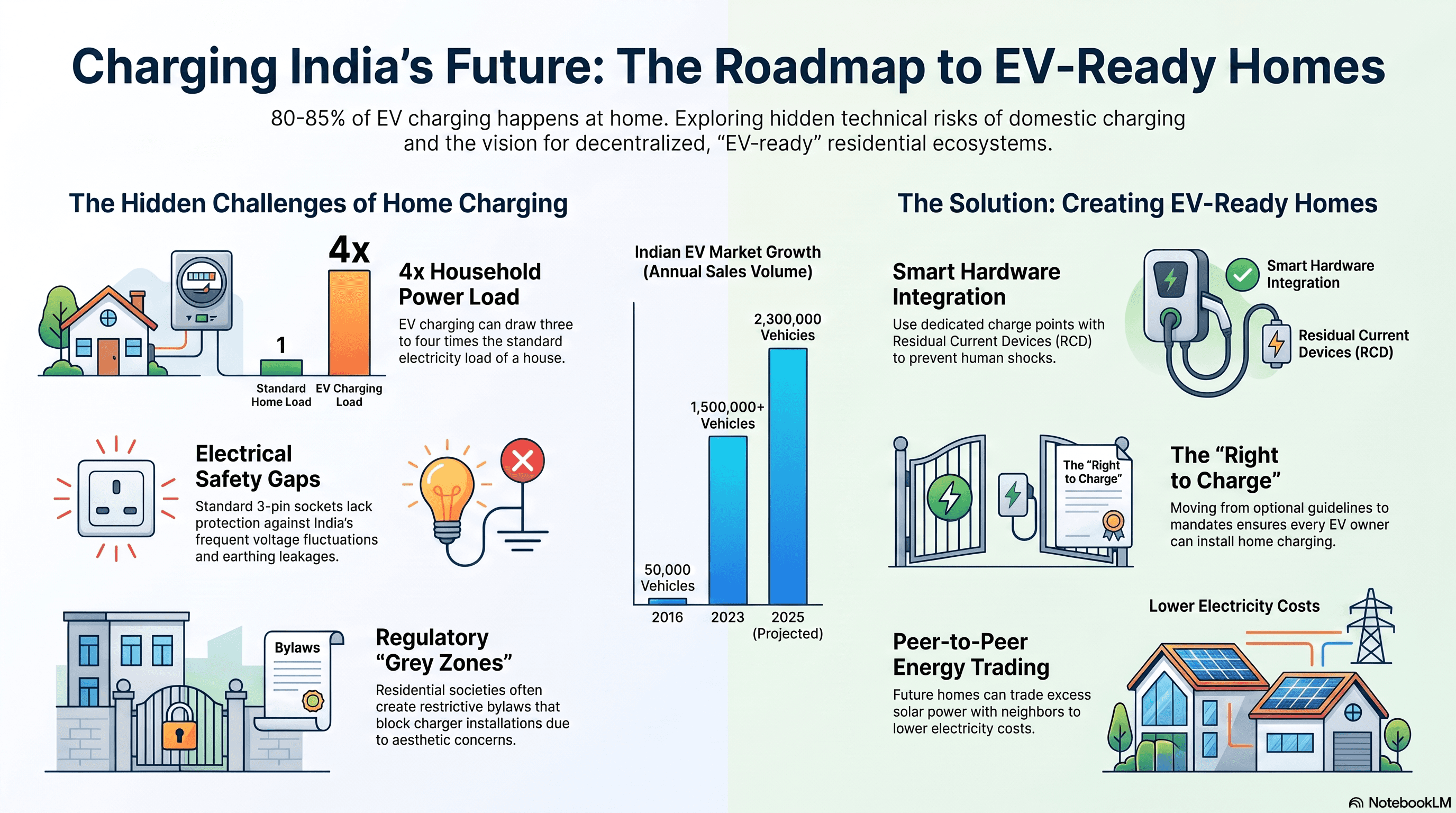
India sold 23 lakh electric vehicles in 2025. EV sales have grown from 0.5 lakh in 2016, a 46-fold increase in under a decade. Two-wheelers and three-wheelers account for approximately 91% of that total, meaning the real EV user in India is not a corporate car-owner with a private garage. She is a delivery worker in UP. He is a passenger auto driver in Assam. They are you and me, navigating apartment complexes and shared basements.
And yet, the dominant conversation about EV charging in India has centred almost entirely on public charging stations, highway corridors, and fast-charging networks. These matter. But global evidence is unambiguous: 80% of EV charging happens at home or at the workplace. In India, for a vehicle fleet that is 91% two and three-wheelers, many of them tied to daily livelihoods that percentage may be even higher.
The real infrastructure problem is not on the highway. It is inside the home.
What 3 Lakh Installations Revealed?
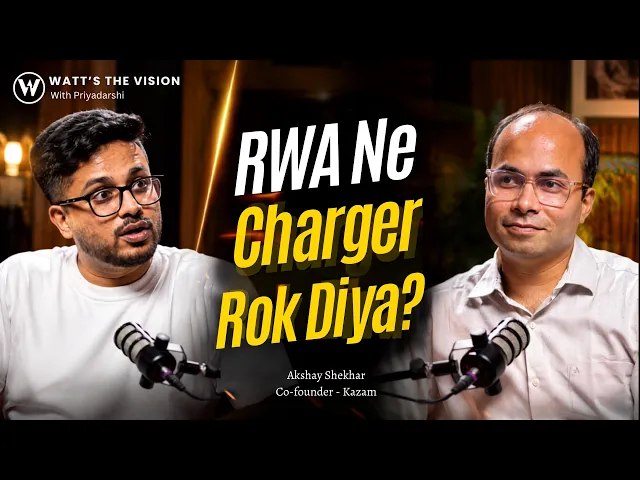
Kazam, one of India's leading EV charging infrastructure companies, has installed home charging points across more than 10,000 pin codes — from metros to tier-four towns, from Pune apartments to the interiors of northeast India. By the time Kazam co-founder and CEO Akshay Shekhar sat down with Watt's the Vision, the company had completed over three lakh residential installations across its OEM partnerships with Bajaj, Mahindra, and others.
What those installations revealed was not what the EV industry expected.
In large parts of northeast India, homes receive electricity that swings from 50 volts to 400 volts — against a promised supply of 230 volts with a maximum 5% variation. Earthing infrastructure is absent in thousands of homes where Kazam installed charge points. In many cases, the earthing problem is not even at the house level — it is at the transformer level, meaning the entire neighbourhood is at risk, not just one household.
Voltage fluctuations, undersized wiring, overloaded distribution transformers, absent circuit protection devices — these are not edge-case problems. They are structural features of India's residential electricity infrastructure that the EV transition is now colliding with at scale.
"The load of an EV charger is three to four times the total load of a typical Indian home," Shekhar explained on the show. "It is very, very risky to charge from a normal socket. Not just for you — for the vehicle and for the house."
Five Barriers the Industry Does Not Talk About
The Kazam × AEEE report identifies five interconnected categories of barriers that together explain why residential EV charging remains a largely unsolved problem in India.
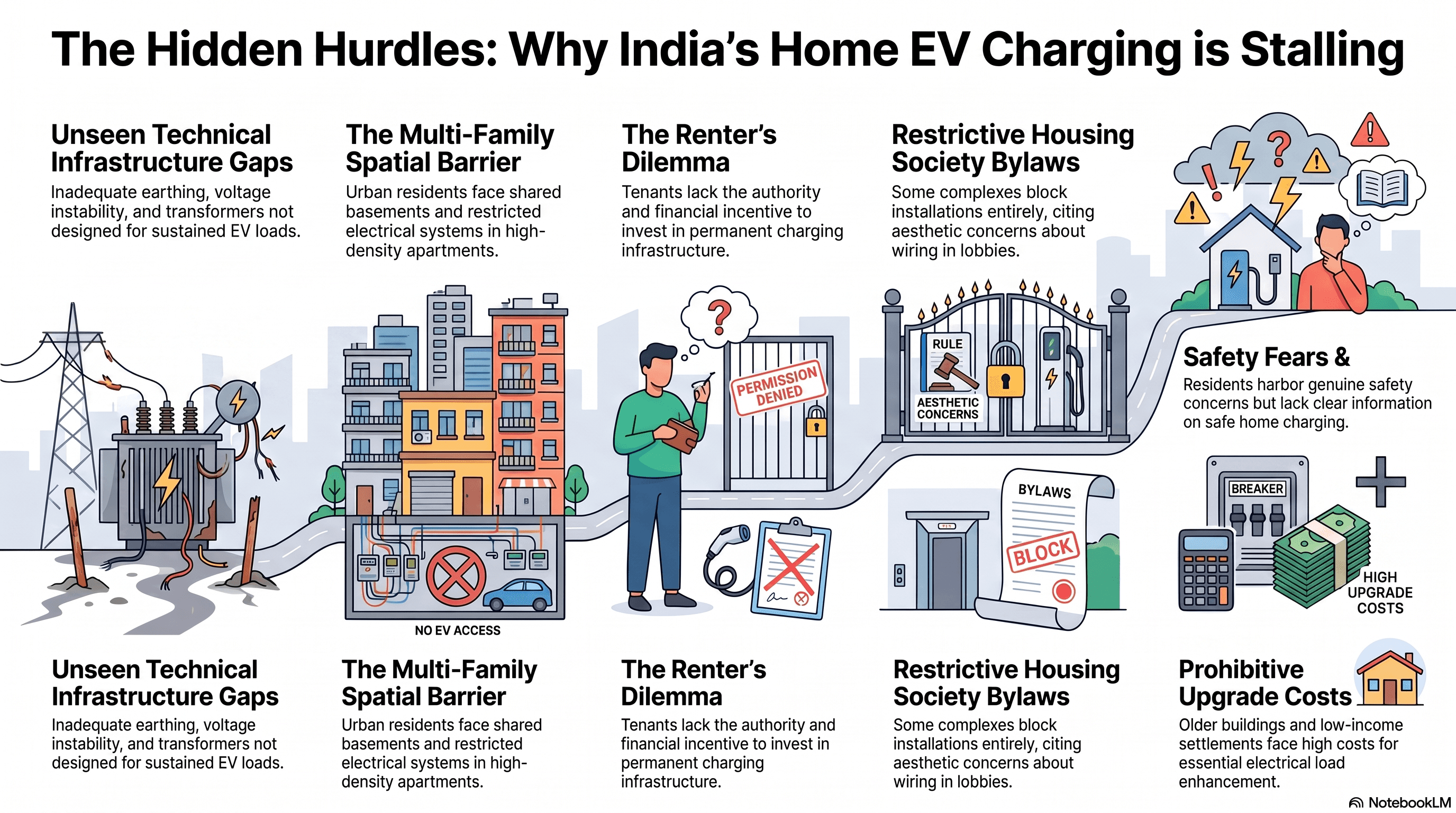
Technical barriers include inadequate earthing, voltage instability, undersized wiring, and distribution transformers not designed for sustained EV loads. These are not visible at the point of purchase. They surface after the EV arrives home.
Structural and spatial barriers affect the majority of urban India, where residents live in multi-family apartments with shared basements and restricted electrical systems. Renters face an additional layer of constraint — they lack both the authority and the financial incentive to invest in charging infrastructure.
Legal and governance barriers are perhaps the most underappreciated. India's housing societies are not governed by any central ministry. They can create their own bylaws — and many have. Some high-end apartment complexes in Delhi and Mumbai have blocked EV charger installation entirely, citing aesthetic concerns about wiring in lobbies and basements. As Shekhar described on the show: "There are societies saying they will not allow it because it will spoil the look in their basement."
Social and behavioural barriers include genuine safety fears — fears that are not entirely unfounded — combined with a lack of clear information about what makes home charging safe, and who is responsible for making it so.
Economic barriers round out the picture. In older buildings, rental housing, and lower-income settlements, the cost of achieving charging readiness — including electrical upgrades, certified EVSE installation, and load enhancement — can be prohibitive without targeted financial support.
RWAs: India's Unofficial EV Regulators
Housing societies occupy a peculiar position in India's EV transition. They are the de facto gatekeepers of residential EV charging in urban India, yet they operate outside any formal regulatory framework for this purpose.
"They create their own bylaws," Shekhar noted. "When somebody is creating their own laws, they are regulating that community."
The fire NOC situation illustrates the problem clearly. Getting a fire no-objection certificate for basement charging requires a document that, in many jurisdictions, does not yet have a defined format. Fire departments — with entirely legitimate safety concerns about battery fires in confined basement spaces — are refusing to issue clearances because the guideline infrastructure for doing so simply does not exist. The result is a governance vacuum in which the RWA becomes the decision-maker by default.
The Ministry of Housing and Urban Affairs has issued a guideline that grants residents the right to install private charging points if they follow safety norms. But guidelines are not mandates. "Nobody follows a guideline," Shekhar said plainly. "It's not a mandate."
What an EV-Ready Home Actually Looks Like
For someone considering an EV purchase, the practical question is: what does it take to make a home genuinely charging-ready?
The Kazam × AEEE report defines an EV-ready home as one that can safely deliver sustained electrical load for EV charging, protect users and equipment from electrical faults, operate reliably under variable grid conditions, and accommodate future increases in EV demand.
In practice, this means: adequate sanctioned load with a dedicated charging circuit; compliant wiring and earthing; appropriate circuit protection including residual current devices and surge protection; a dedicated EV sub-meter where feasible; and certified EVSE — an EV-specific charging device — rather than a general-purpose socket.
The sub-meter piece matters for a reason most EV buyers have not considered. When a home installs a sub-meter for EV charging, the DISCOM gains visibility into EV load patterns in that area. This allows distribution companies to upgrade transformer capacity before transformers fail under aggregate EV load — rather than after. The data layer that connects individual home charging to grid planning is entirely absent in India today.
The Unexpected Opportunity: Selling Electricity from Home
The report's vision extends beyond safety compliance into an economic opportunity that most EV buyers are unaware of.
Electricity is fully delicensed for small-scale sale in India. A homeowner with a sub-meter and a properly installed charge point can legally sell electricity to neighbours, to visitors, or — in a society context — through a common meter shared by the community. Kazam has already piloted peer-to-peer energy trading in Lucknow and Delhi through the Unified Energy Interface, a digital public infrastructure for energy modelled on the UPI framework for payments. Residents with rooftop solar can sell surplus power to neighbours who do not have solar, at mutually agreed prices, through an app.
This is not a future possibility. It is happening now, at small scale, in Indian cities.
If home charging infrastructure is treated not just as a safety requirement but as an economic entry point, the entire framing shifts. An EV-ready home is not a cost — it is the foundation for participation in India's emerging energy economy.
India @ 100: The Frame That Changes Everything
Akshay Shekhar traces the arc of GDP growth through a historical lens: India's economic prominence two centuries ago rested on agricultural abundance. The industrial revolution — enabled by electricity — created the hockey-stick growth curve that defined the 20th century. The AI wave, he argues, is the next equivalent transformation, with electricity once again as the enabling infrastructure.
India has exceptional natural energy endowments: among the world's highest solar irradiation, perennial rivers for hydroelectricity, the largest thorium deposits on Earth, and substantial coal reserves as a transitional resource. The conditions for energy self-sufficiency exist. The question is whether the infrastructure layer — from the national grid down to the earthing connection in a residential basement — will be built in time to carry the transition.
The Net-Zero Transition Starts at Home report is a data-backed argument that this infrastructure layer must be treated as a national priority, not a downstream afterthought. India does not lack standards. It lacks a coordinated implementation framework that translates standards into mandates, mandates into dealer responsibilities, and dealer responsibilities into homes that are genuinely ready before the EV arrives.
The goal is straightforward: the readiness of homes must keep pace with the adoption of vehicles.
India is buying EVs. The question of whether Indian homes are ready to charge them is no longer hypothetical — it is urgent.
This article is based on Watt's the Vision Episode 23 — a conversation with Akshay Shekhar, Co-Founder and CEO of Kazam, anchored around the launch of the AEEE × Kazam report Net-Zero Transition Starts at Home: Enabling EV-Ready Residences in India. The report is available at [www.aeee.in] and [www.kazam.in].
Listen to the full episode on YouTube, Spotify, and Apple Podcasts. Search Watt's the Vision or visit wattsthevision.com
Tags: EV charging India · Home EV charging · Residential EV infrastructure · Kazam · AEEE · RWA EV charging · Right to charge · India 2047 · Clean energy India · Electric vehicle adoption · EV safety