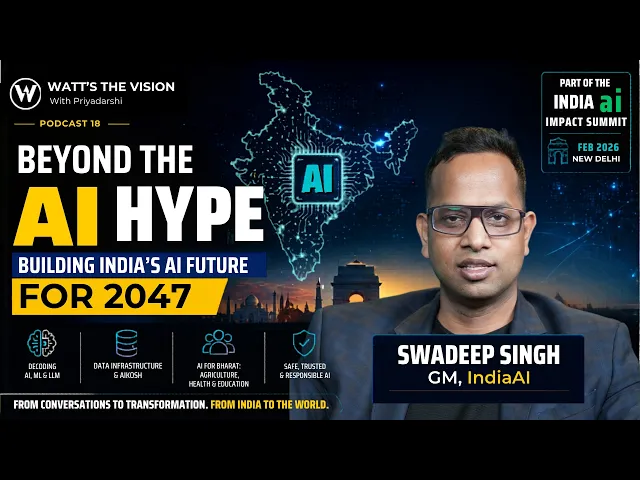
India 2047 Will Be Built on AI | Swadeep Singh on IndiaAI, Data, and Real Impact | WTV Vision 18
India 2047 Will Be Built on AI | Swadeep Singh on IndiaAI, Data, and Real Impact | WTV Vision 18
India’s artificial intelligence story is entering a more consequential phase. The first wave was about fascination: ChatGPT, Gemini, Claude and Perplexity turned AI into a mass conversation. The next wave is about economics. Can AI improve productivity, widen access and create value beyond India’s metros?
That is the central case Swadeep Singh, general manager at the IndiaAI Mission, makes in a conversation on Watt’s the Vision. His argument is simple: India should stop treating AI as a novelty and start treating it as infrastructure. By 2030–35, he says, people should ideally stop talking about AI itself and focus instead on the systems it improves.
That distinction matters. If AI in India remains limited to chatbot demos and urban convenience, the country will miss its bigger opportunity.
By 2030–35, people should ideally stop talking about AI itself and focus instead on the systems it improves.
The real India AI story may begin outside big cities
Singh’s most compelling insight is that India’s AI future will not be defined only in Bengaluru, Gurugram or Hyderabad. It will be shaped in places like Bareilly, Gaya and smaller-town India.
He imagines a future in which a local artisan, trader or craftsperson can use AI in Bhojpuri or another Indian language to understand overseas demand, improve product design, negotiate with a buyer abroad and sell directly into international markets. In that model, AI is not just a software layer. It becomes a bridge between local skill and global commerce.
That idea carries real economic weight. India has millions of small producers, service providers and entrepreneurs whose biggest barriers are not capability, but market access, language and discoverability. If AI can reduce those frictions, it can become a multiplier for India’s MSME economy.
India’s AI edge is scale, diversity and real-world demand
India’s AI conversation often gets framed as a race to catch up with the US or China on frontier models. Singh frames it differently. India’s advantage lies in its population scale, linguistic diversity and breadth of use cases. In his view, the country’s AI story will be driven by the masses, not by one company, one ministry or one elite tech ecosystem.
That also explains why global AI firms are aggressively pushing into India. Singh describes the current moment as part of a broader “data war”, where platforms are competing for adoption, feedback loops and usage at scale. In that context, India is not merely a user market; it is one of the most valuable training grounds for AI products that want to succeed globally.
India’s AI opportunity is not just about engineering talent. It is about scale, languages and unmet demand.
Healthcare may be where AI matters most
If one sector stands out in Singh’s roadmap, it is healthcare. His point is that India’s challenge is not only medical expertise, but accessibility. Too often, people receive care only when their condition has already deteriorated. AI-assisted diagnostics, remote monitoring and better digital health systems can help move care earlier, closer and faster.
He describes a future where basic assessments can happen through local digital systems, where patient histories are easier to access, and where telehealth support can intervene before a condition becomes critical. That would not replace doctors. It would make scarce medical capacity go further.
This is an important distinction for the AI debate in India. The most meaningful gains may not come from flashy consumer tools, but from systems that reduce friction in sectors where access is already broken.
The three bottlenecks India must solve
For all the optimism, Singh is clear-eyed about the constraints. In his framework, India must solve three bottlenecks if AI is to scale meaningfully:
Data: India has large amounts of raw data, but not enough high-quality, curated, AI-ready and easily accessible data.
Compute: Serious AI development needs processing power at scale, and that access must expand beyond a small set of institutions.
Know-how: Adoption needs more than curiosity. People need the confidence, literacy and practical ability to use the technology well.
This is also where he places the role of the IndiaAI Mission: democratising access through pillars focused on datasets, compute, startups, applications, skills, trusted AI and foundation models.
The real AI challenge in India is not just building models. It is building the ecosystem around them.
Why India should not simply copy the West
Singh rejects the idea that India’s AI role is to follow global trends and adapt them later. He points to India’s own digital public infrastructure story — including UPI and DigiLocker — as proof that the country can build systems suited to its own realities and, in doing so, influence the world.
The same principle, he suggests, should apply to AI. India’s AI stack will likely need to be more multilingual, more voice-first and more tightly linked to daily economic use cases than many Western systems have been.
That is the strategic point. The question is not whether India builds a clone of ChatGPT. It is whether it builds AI that works better for Indian realities than imported systems do.
The metric that matters: ROI, not hype
Perhaps the most grounded part of the conversation is Singh’s repeated emphasis on return on investment. He warns founders and developers against building AI products simply because the technology is fashionable. The real test, he argues, is whether the system delivers measurable gains in productivity, speed, output and value.
That may be the cleanest lens through which to judge India’s AI future. The country does not need more AI noise. It needs AI that helps people do more, earn more, access more and solve more.
If that happens, India’s AI success will not be measured by how often people use the word “AI”. It will be measured by how little they need to.
Based on Vision 18 of Watt's the Vision by Priyadarshi Singh — a future-focused podcast exploring the ideas, people, and blueprints shaping India's road to 2047.
Watch the full episode with Swadeep Singh on YouTube.
Listen to the full conversation on Spotify.
India 2047 Starts Here.
Tags: IndiaAI Mission, Artificial Intelligence India, Swadeep Singh IndiaAI, AIKosha, India AI Impact Summit 2026, Indian LLM, Multilingual AI India, AI Data India, MeitY AI, Watt's the Vision Podcast
India’s artificial intelligence story is entering a more consequential phase. The first wave was about fascination: ChatGPT, Gemini, Claude and Perplexity turned AI into a mass conversation. The next wave is about economics. Can AI improve productivity, widen access and create value beyond India’s metros?
That is the central case Swadeep Singh, general manager at the IndiaAI Mission, makes in a conversation on Watt’s the Vision. His argument is simple: India should stop treating AI as a novelty and start treating it as infrastructure. By 2030–35, he says, people should ideally stop talking about AI itself and focus instead on the systems it improves.
That distinction matters. If AI in India remains limited to chatbot demos and urban convenience, the country will miss its bigger opportunity.
By 2030–35, people should ideally stop talking about AI itself and focus instead on the systems it improves.
The real India AI story may begin outside big cities
Singh’s most compelling insight is that India’s AI future will not be defined only in Bengaluru, Gurugram or Hyderabad. It will be shaped in places like Bareilly, Gaya and smaller-town India.
He imagines a future in which a local artisan, trader or craftsperson can use AI in Bhojpuri or another Indian language to understand overseas demand, improve product design, negotiate with a buyer abroad and sell directly into international markets. In that model, AI is not just a software layer. It becomes a bridge between local skill and global commerce.
That idea carries real economic weight. India has millions of small producers, service providers and entrepreneurs whose biggest barriers are not capability, but market access, language and discoverability. If AI can reduce those frictions, it can become a multiplier for India’s MSME economy.
India’s AI edge is scale, diversity and real-world demand
India’s AI conversation often gets framed as a race to catch up with the US or China on frontier models. Singh frames it differently. India’s advantage lies in its population scale, linguistic diversity and breadth of use cases. In his view, the country’s AI story will be driven by the masses, not by one company, one ministry or one elite tech ecosystem.
That also explains why global AI firms are aggressively pushing into India. Singh describes the current moment as part of a broader “data war”, where platforms are competing for adoption, feedback loops and usage at scale. In that context, India is not merely a user market; it is one of the most valuable training grounds for AI products that want to succeed globally.
India’s AI opportunity is not just about engineering talent. It is about scale, languages and unmet demand.
Healthcare may be where AI matters most
If one sector stands out in Singh’s roadmap, it is healthcare. His point is that India’s challenge is not only medical expertise, but accessibility. Too often, people receive care only when their condition has already deteriorated. AI-assisted diagnostics, remote monitoring and better digital health systems can help move care earlier, closer and faster.
He describes a future where basic assessments can happen through local digital systems, where patient histories are easier to access, and where telehealth support can intervene before a condition becomes critical. That would not replace doctors. It would make scarce medical capacity go further.
This is an important distinction for the AI debate in India. The most meaningful gains may not come from flashy consumer tools, but from systems that reduce friction in sectors where access is already broken.
The three bottlenecks India must solve
For all the optimism, Singh is clear-eyed about the constraints. In his framework, India must solve three bottlenecks if AI is to scale meaningfully:
Data: India has large amounts of raw data, but not enough high-quality, curated, AI-ready and easily accessible data.
Compute: Serious AI development needs processing power at scale, and that access must expand beyond a small set of institutions.
Know-how: Adoption needs more than curiosity. People need the confidence, literacy and practical ability to use the technology well.
This is also where he places the role of the IndiaAI Mission: democratising access through pillars focused on datasets, compute, startups, applications, skills, trusted AI and foundation models.
The real AI challenge in India is not just building models. It is building the ecosystem around them.
Why India should not simply copy the West
Singh rejects the idea that India’s AI role is to follow global trends and adapt them later. He points to India’s own digital public infrastructure story — including UPI and DigiLocker — as proof that the country can build systems suited to its own realities and, in doing so, influence the world.
The same principle, he suggests, should apply to AI. India’s AI stack will likely need to be more multilingual, more voice-first and more tightly linked to daily economic use cases than many Western systems have been.
That is the strategic point. The question is not whether India builds a clone of ChatGPT. It is whether it builds AI that works better for Indian realities than imported systems do.
The metric that matters: ROI, not hype
Perhaps the most grounded part of the conversation is Singh’s repeated emphasis on return on investment. He warns founders and developers against building AI products simply because the technology is fashionable. The real test, he argues, is whether the system delivers measurable gains in productivity, speed, output and value.
That may be the cleanest lens through which to judge India’s AI future. The country does not need more AI noise. It needs AI that helps people do more, earn more, access more and solve more.
If that happens, India’s AI success will not be measured by how often people use the word “AI”. It will be measured by how little they need to.
Based on Vision 18 of Watt's the Vision by Priyadarshi Singh — a future-focused podcast exploring the ideas, people, and blueprints shaping India's road to 2047.
Watch the full episode with Swadeep Singh on YouTube.
Listen to the full conversation on Spotify.
India 2047 Starts Here.
Tags: IndiaAI Mission, Artificial Intelligence India, Swadeep Singh IndiaAI, AIKosha, India AI Impact Summit 2026, Indian LLM, Multilingual AI India, AI Data India, MeitY AI, Watt's the Vision Podcast